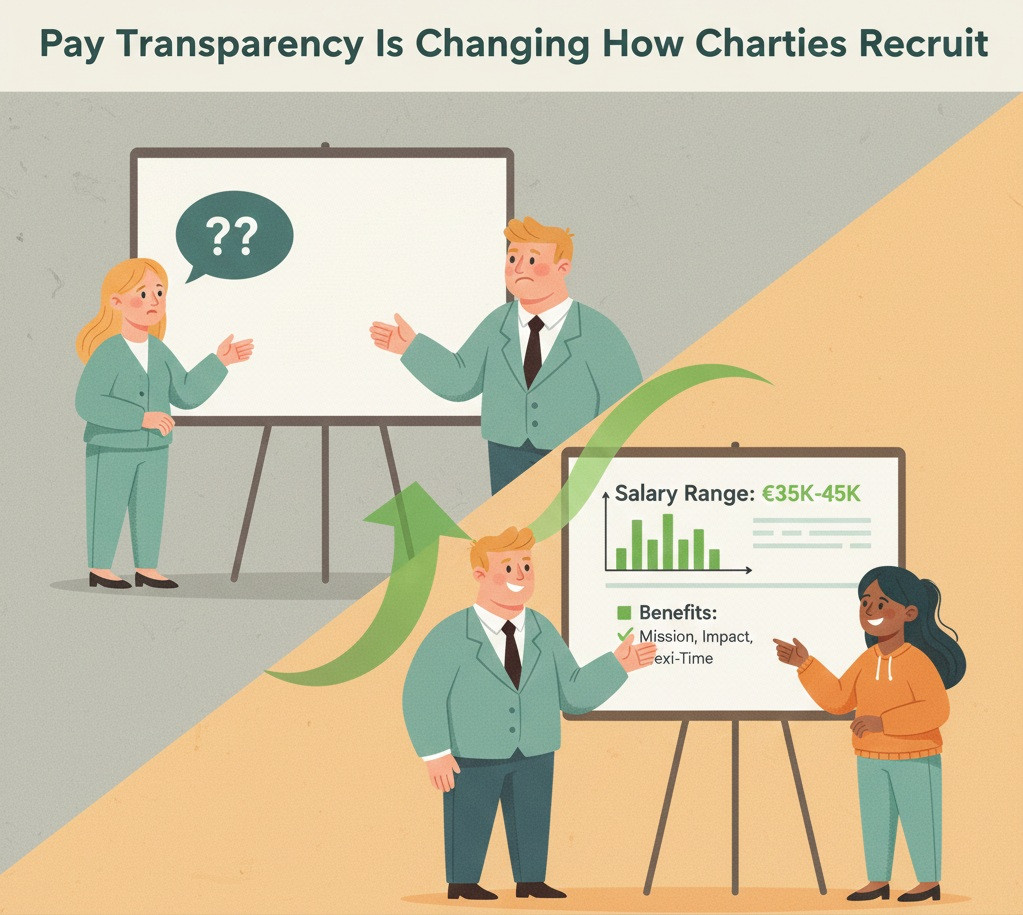
As Ireland moves towards implementing the EU Pay Transparency Directive by June 2026, many charities are beginning to consider what greater openness around pay will mean for their ability to recruit in a labour market where competition for skilled staff is already intense.
The concern that arises first is not about reporting or compliance, but about how salary transparency will affect how roles are viewed, particularly where organisations know that their pay levels will not compare favourably with those of larger or better funded employers.
There is a fear that publishing salary ranges will make roles look less attractive, limit room for discussion, and cause potential candidates to opt out early, before the organisation has had the chance to explain the work, the mission, or the wider value of the role.
Why pay transparency unsettles recruitment
Across much of the charity sector, pay during recruitment has typically been discussed on a case by case basis, with organisations knowing their budget but choosing to manage expectations through conversation rather than stating the full range openly from the start.
Pay transparency moves that information forward, requiring organisations to be clear about limits at the beginning of the process rather than later on.
What changes in practice
When salary ranges are stated upfront, candidates decide earlier whether a role is viable for them, which means that those who apply are more likely to remain engaged and realistic throughout the process.
This does not remove hiring challenges, but it does change where effort is spent, concentrating it on candidates who can take the role on the terms offered.
When external transparency becomes internal
Once pay information is shared openly with candidates, it also becomes easier for staff to compare roles and ask how differences are justified, shifting attention from market comparison to internal coherence.
Recruitment decisions matter here, because each new role sets a benchmark that contributes to how pay is understood across the organisation over time.
Recruitment as the point of leverage
Reworking historic pay across an entire organisation is complex and often slow, particularly where roles have evolved organically.
Recruitment offers a simpler point of leverage, because each new hire creates an opportunity to define roles clearly, position them sensibly alongside others, and reinforce a consistent approach to pay without reopening every past decision.
Pay transparency does not require charities to have had perfect systems in the past, nor does it require them to compete on salary alone.
What it does require is clarity, consistency, and the ability to explain decisions going forward.
For organisations that treat recruitment as part of that work, transparency becomes less a threat to hiring and more a way of strengthening trust and confidence on both sides.
Author note
This article reflects the experience of Purpose+Impact, a social enterprise that supports charities with recruitment and hiring design, including aligning recruitment practice with the EU Pay Transparency Directive, in a way that is practical, proportionate, and grounded in the realities of the sector.